


Hi Freshworks Community! ✋
I’m joining the Freshworks Community from Getint, and I wanted to start with a topic that sits right between customer support and development: what happens when a Freshdesk ticket needs to become work for a team using Jira?
There’s also a reason for the timing. Our Jira Freshdesk Connector by Getint is now available on the Freshworks Marketplace, so this felt like a good opportunity not only to introduce it, but also to open a broader discussion about how your teams handle this workflow in practice.
Connecting the tools is only one part of the story. The more interesting challenge is what happens between the moment a support agent identifies a problem and the moment the development team starts working on it.
- How much information needs to move?
- Who owns the issue after escalation?
- How does support learn that something changed in Jira?
These decisions can have a much bigger impact on the workflow than simply creating a connection between the two platforms.
The familiar scenario: a support ticket becomes an engineering task
Imagine a customer reports a bug through Freshdesk. The support agent gathers additional information, asks a few follow-up questions, receives screenshots or logs, and eventually confirms that this is something the development team needs to investigate.
Without a connected workflow, someone usually has to create the Jira work item manually and decide which parts of the Freshdesk conversation should be copied across. Later, when engineering makes progress, support needs that information back so they can keep the customer informed. That can mean checking Jira, messaging the development team, or manually updating the Freshdesk ticket.
None of these actions is particularly difficult on its own. The problem appears when the same handoff happens dozens or hundreds of times. Information gets duplicated, updates arrive late, and both teams spend additional time coordinating work across two separate systems. It happens.
This is where a Freshdesk–Jira integration becomes useful, but it also introduces an important question: which parts of the handoff should be automated, and which decisions should remain with the teams involved? Below I break down the most common issues that users share with us.
Pain point 1: deciding which tickets actually belong in Jira
The first temptation may be to automatically send every relevant-looking Freshdesk ticket to Jira, but that usually creates more noise than value.
A support team may handle billing questions, configuration problems, account requests, product bugs, feature suggestions, and many other types of customer conversations. Engineering probably needs only a fraction of them, so the escalation criteria should be defined before synchronization is configured.
For example, a team might decide that confirmed product bugs should create Jira work items automatically, feature requests should go to a dedicated Jira project, and technical issues should only be escalated after an L1 or L2 investigation. Another team might use a specific Freshdesk group, category, or field as the condition for sending a ticket to Jira.
The exact rule will differ between organizations. The important part is that the integration should support an existing escalation process rather than determine that process for you.
Pain point 2: getting enough context into Jira
Creating a Jira work item is usually the easy part. Making sure engineering receives enough useful context is more difficult.
A ticket description alone might not tell the whole story, especially if the most important information appeared later in the customer conversation. Developers may need reproduction steps, screenshots, logs, priority information, product details, or values stored in custom Freshdesk fields before they can properly investigate the problem.
At the same time, sending every available Freshdesk field to Jira isn't necessarily helpful. It can clutter the issue with information that engineering doesn't need and make the integration harder to maintain.
A useful rule is to synchronize information because the other team needs it, not simply because the field exists. Start with the information required to understand and act on the issue, then expand the mapping only when there is a clear reason to do so.
Pain point 3: support still needs to know what happens next
Moving information from Freshdesk into Jira solves only half of the handoff.
Suppose the developer starts working on the issue, moves it through development and testing, and eventually resolves it. If the Freshdesk agent still has to open Jira or message someone from engineering every time they need an update, the integration has removed some manual work but hasn't solved the communication problem.
This is where two-way synchronization can make sense. Selected Jira changes can return to Freshdesk so support can follow engineering progress without leaving the platform they use to manage the customer relationship.
However, this doesn't mean both workflows need to look identical. Freshdesk might use a relatively simple set of support statuses, while Jira could have separate stages for development, code review, testing, and release. Support may not need visibility into every internal engineering transition. Several Jira statuses could simply correspond to a broader Freshdesk state indicating that engineering is actively working on the issue.
The goal is to map what the statuses mean to each team rather than trying to match identical names one-to-one.
Pain point 4: deciding which comments should cross the boundary
Comments need similar consideration.
Synchronizing every conversation in both directions can quickly become noisy. A Jira thread about implementation details may be useful for developers without adding anything meaningful to the Freshdesk ticket. At the same time, a developer asking support to collect additional information from the customer is exactly the kind of update that should probably reach the Freshdesk agent.
The same applies in the opposite direction. Engineering may need the customer's technical answers or reproduction details, but it doesn't necessarily need every message exchanged as part of the support conversation.
Before configuring comment synchronization, it helps to decide what kind of communication genuinely helps the other team move the issue forward. This keeps the connection useful without turning both systems into copies of each other's conversations.
Pain point 5: avoiding two versions of the truth
Shared fields introduce another challenge: what happens when users in Freshdesk and Jira both update the same information?
Priority is a good example. Support may consider a ticket urgent because a customer is blocked, while engineering uses its own prioritization process when deciding what should enter the development queue. If both systems can freely overwrite the same value, it becomes unclear which one should be trusted.
The same issue can occur with statuses, assignees, categories, custom fields, or other shared information. For important fields, it is worth defining ownership in advance. Some values may be controlled by Freshdesk, others by Jira, while a smaller set may genuinely need to be editable and synchronized in both directions.
This sounds like a small configuration decision, but it can prevent a lot of confusion once the integration is used at scale.
A simple workflow to start with
If I were introducing Freshdesk–Jira synchronization to a team for the first time, I wouldn't try to automate every possible scenario immediately. I would start with one clear workflow: a customer reports a bug in Freshdesk, support validates it, a Jira work item is created with the necessary context, engineering works on it in Jira, and the most important progress updates return to Freshdesk so support can keep the customer informed.
Then I would test that workflow using real examples rather than idealized test tickets. Doing this usually makes it much easier to spot missing context, unnecessary fields, confusing status mappings, or updates that are being synchronized without adding any value.
Once that basic flow works reliably, additional ticket types, Jira projects, custom fields, or more advanced conditions can be introduced gradually.
Where Getint may fit
There are different ways to connect Freshdesk and Jira, from APIs and custom automation to dedicated integration applications. Since integrations are what we work on at Getint, I'll briefly mention our approach as well.
As I mentioned at the start, the Jira Freshdesk Connector by Getint is now available on the Freshworks Marketplace. It allows teams to configure how information moves between Freshdesk and Jira, including one-way or two-way synchronization and mappings for tickets and issues, statuses, comments, attachments, priorities, and relevant standard or custom fields.
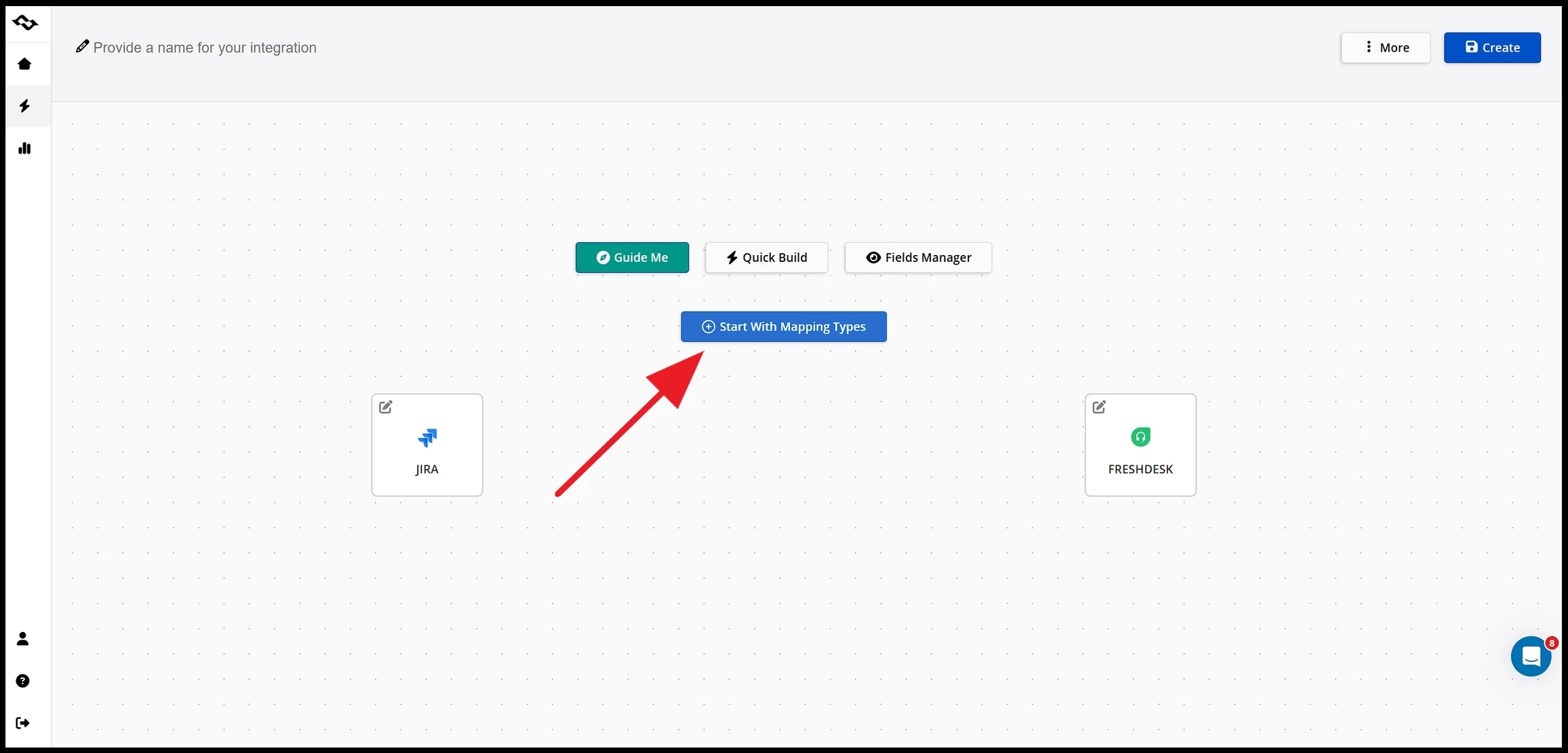
Find the app here:
Jira Freshdesk Connector by Getint on Freshworks Marketplace
For us, though, the configuration itself is only part of a successful integration. Before choosing fields or synchronization directions, it's worth agreeing on what the support-to-development workflow should actually look like.
Questions worth answering before connecting Freshdesk and Jira
Before setting up the integration, I would put a few questions in front of both teams:
- Which Freshdesk tickets should reach Jira?
- At what point should support escalate them?
- What information does engineering need to start working?
- Which Jira updates does support need back in Freshdesk?
- Which system should own shared fields such as status or priority?
- Which comments should be visible across both systems?
- Does the workflow really require two-way synchronization?
- Who will maintain the connection when either workflow changes?
If support and engineering agree on these points first, the technical configuration becomes much easier. More importantly, the resulting integration reflects how people actually work instead of simply moving as much data as possible between two platforms.
The goal is a better handoff, not simply more synchronization
A Freshdesk–Jira integration can remove repetitive work, but synchronization itself shouldn't be the goal. The real objective is making collaboration between support and development easier.
Support agents should be able to continue managing customer relationships in Freshdesk, while developers investigate and resolve technical work in Jira. Neither team should have to become a regular user of the other platform just to know what is happening with a shared issue.
That's also why I'm curious about how other Freshdesk teams approach this.
If your support team uses Freshdesk and your development team uses Jira, how does the handoff work today? Do agents create Jira work items manually, have you automated only certain parts of the process, or are the two systems already synchronized? And which part of that workflow still creates the most friction for your team?
I'd love to hear how you're handling it. Cheers!